Hemris · Digital systems engineering

Everything is a system. We engineer the parts that hold it together.

We design, build and connect software, automation and infrastructure that work together to solve practical problems. Today, we focus on helping organisations build better systems for the way they work.

About Hemris

Technology doesn't exist in isolation.

Hemris is a digital systems engineering company that designs, builds and connects technology systems to solve practical problems.

We believe the real value of technology lies not just in individual applications, devices or infrastructure, but in how they work together. We look at the wider picture: the components, the connections, the people and the processes. That tells us what a system needs to do and how technology can help it do that better.

Today, we apply this approach through software engineering, systems integration, automation and network infrastructure for organisations. These are the foundations of our work as we continue to develop our capabilities across new technologies and domains.
A system you'll recognise

Most technology problems aren't technology problems.

The parts of a typical business and who keeps each one running
PartWhat it doesWho keeps it running
Sales appRecords what was soldThe cashier
Inventory spreadsheetTracks what is leftThe storekeeper
Accounting softwareKeeps the booksThe accountant
A group chatWhere the real decisions happenEveryone
A personMoves information between all of the aboveNobody planned this

Each one worked. Together they made the place harder to run.

So we ask first

Not

“What do you want built?”

But

“How does work move through your company, and where does it get stuck?”

Everything we do follows from the answer.

Services

Software, connected systems and infrastructure, designed to work together.

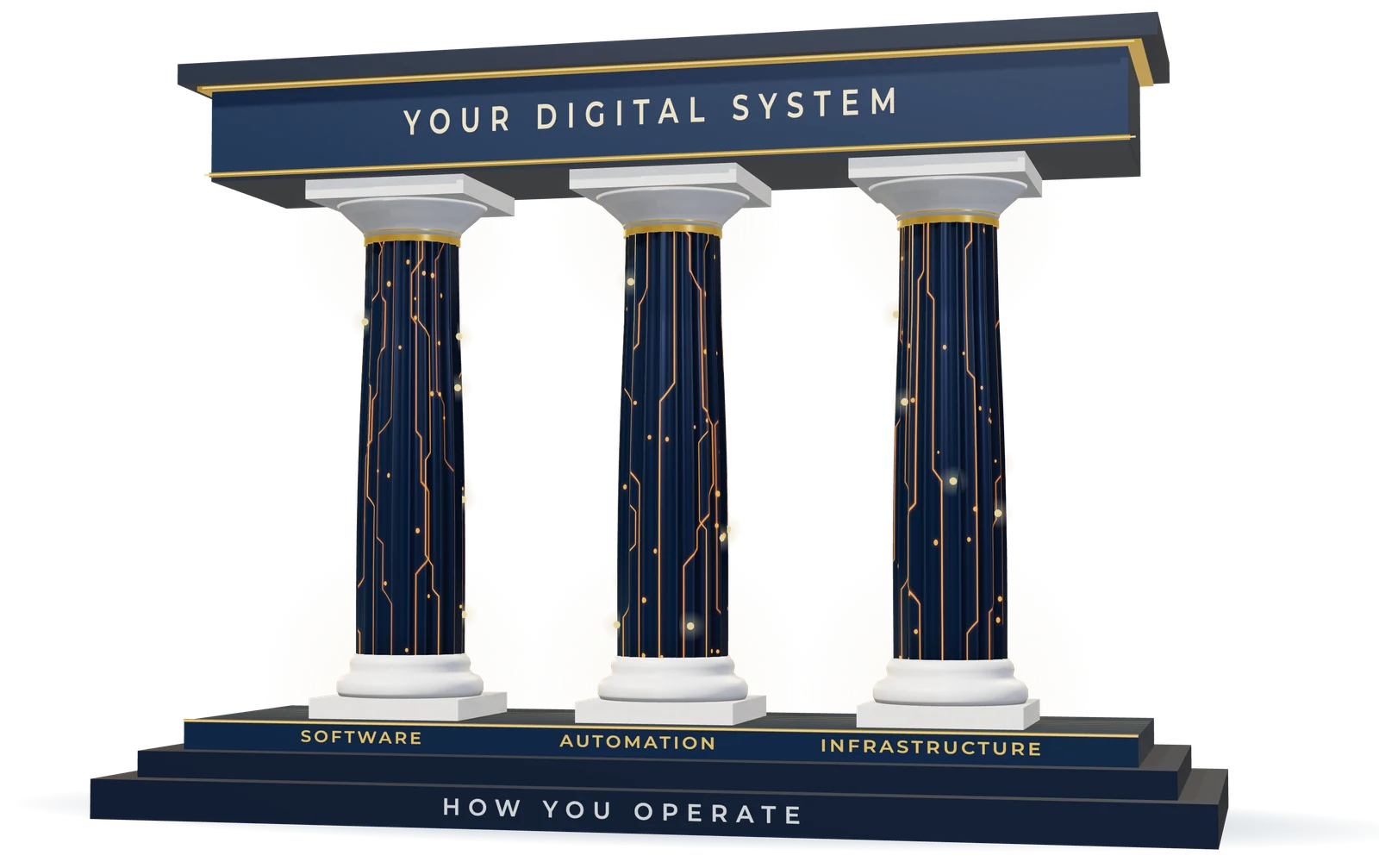
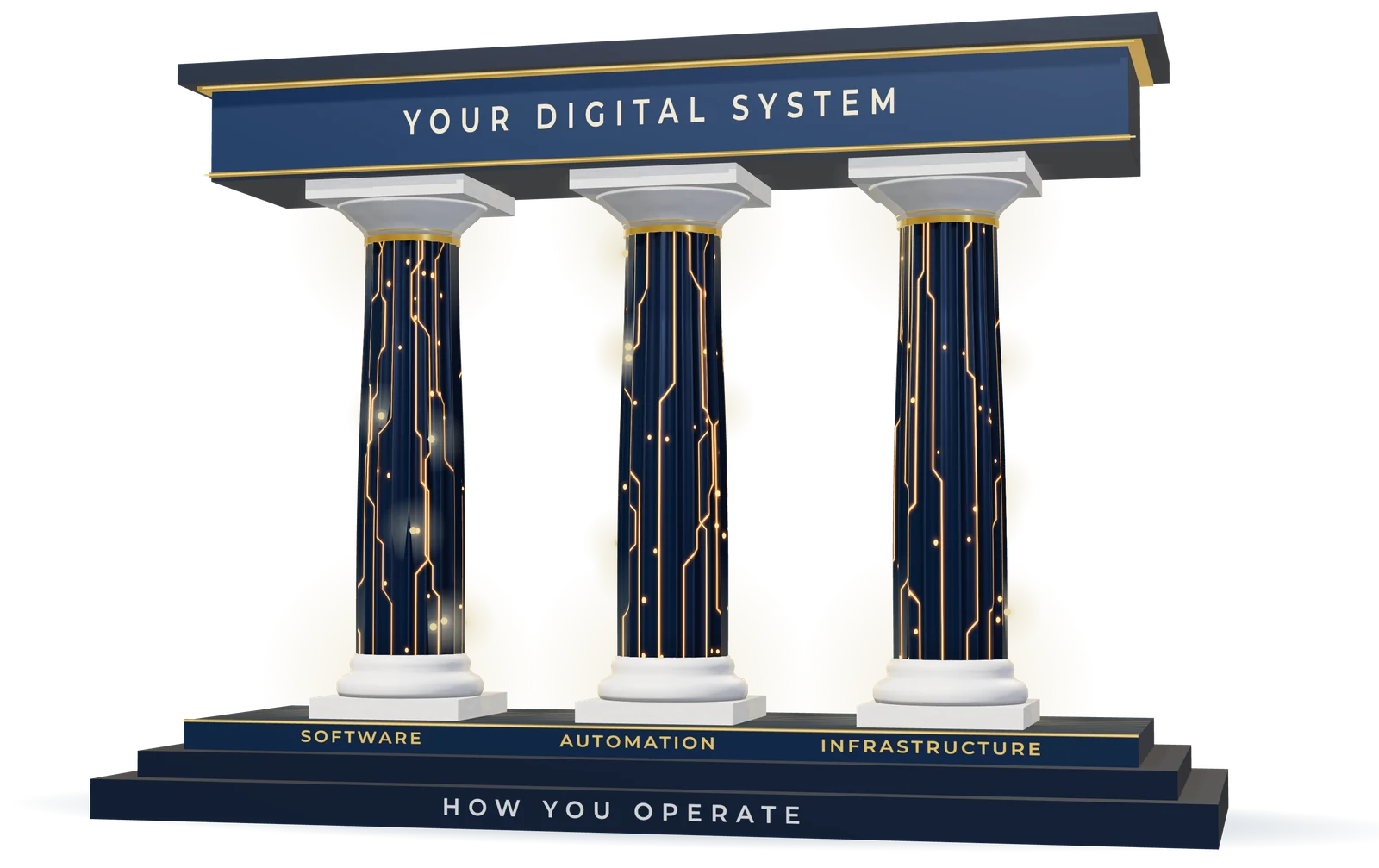
When one is weak, the whole system feels it, no matter how good the other two are. So we design all three together, from the start.

Three navy columns traced with glowing gold circuits, labelled Software, Automation and Infrastructure, hold up a beam labelled Your digital system. They stand on a base labelled How you operate.
Web appMobilePortalBusiness logic · APIDatabaseINTERFACELOGICDATA

Pillar 01What people use

Software Engineering

Systems your staff and customers really use, built around how you already work, not the other way round.

What it covers

  • Business management systems
  • Inventory and POS
  • Web and mobile applications
  • Customer and staff portals
  • Platforms for schools, clinics and services
See the full pillar: Software Engineering
OrdersInventoryAccountingMessages

Pillar 02How work flows

Systems Integration & Automation

We analyse how information moves through your company, find the bottlenecks, and connect the separate pieces into one working system.

What it covers

  • Business process automation
  • Systems integration and data sync
  • Payments, banks and couriers
  • Reports that build themselves
See the full pillar: Systems Integration & Automation
Cloud & serversCore networkBackupMonitorHead officeBranchWi-Fi

Pillar 03What it all runs on

Network & IT Infrastructure

Your software is only as dependable as the infrastructure underneath it.

What it covers

  • Network design, LAN and WAN
  • Wireless for offices and multi-site
  • Servers and cloud
  • Monitoring and backup
  • Security
  • Ongoing support
See the full pillar: Network & IT Infrastructure

One example of our approach · Not a client project

How we'd map a business like yours.

Take a restaurant with two branches, taking orders at the counter, by phone and through chat, with riders for delivery.

1 · What the owner tells us

  • “Orders come in three different ways.”
  • “We count stock in a notebook every night.”
  • “I only know if we made money at the end of the month.”

2 · How it actually works

Every order ends up with one cashier, copied by hand into the POS. The kitchen hears orders shouted across the room. Stock lives in a notebook, suppliers are called when someone notices a shortage, and riders get addresses by voice note.

3 · Where it gets stuck

  1. 1Chat orders are re-typed into the POS. Every copy is a chance for a mistake.
  2. 2Stock is counted on paper at night, so nobody knows what is running out until it has.
  3. 3The owner is cut off. Profit is a month-end tally, so decisions wait four weeks for their numbers.

4 · What we would build

Software
One order system for counter, phone and chat, with a kitchen display and a daily report for the owner.
Automation
Chat orders flow straight in. Each sale deducts stock by recipe, and low stock triggers a reorder.
Infrastructure
Both branches on one reliable network, with backup internet so a dropped line doesn't stop orders.

Same method, any operation

  • Restaurantsthis example
  • Logistics
  • Manufacturing
  • Clinics
  • Schools
  • Retail
  • Farms
Example: a restaurant, before and afterBefore: three order channels copied by hand into one cashier, stock kept in a notebook, the owner sees numbers at month end. After: every channel flows into one order system that feeds the POS, the kitchen, live stock, riders and a daily owner report.spokenwrittenre-typedshoutedcounted at nightphone callvoice note123Order systemPOS SYNCTO KITCHENREORDERDAILY REPORTWalk-in counterPhone ordersChat ordersCashier & POSKitchenStock notebookLive stockSuppliersRidersOwner
Illustrative example. Every business is different, so this is the method, not a template.

For growing businesses that have outgrown their tools

  • “Everything works on its own. Nothing works together.”
  • “We've grown, but the way we work hasn't.”
  • “Why are we still doing this by hand?”
  • “I have the numbers. I just can't see the full picture.”
  • “Only one person knows how everything works.”
  • “We keep fixing the same problem.”

If any of these sound familiar, that's a good place to begin.

Let's talk today

Our process

Every project follows the same five stages.

Stage 1: Discovery

We spend time inside your operation before proposing anything.

Stage 2: Design

We design on paper first, in language you can read without us in the room.

Stage 3: Build

We build in stages, so you see it early and tell us what's wrong while it's still cheap to change.

Stage 4: Rollout

You can't close for a week while we install. So we plan the switchover around your working day.

Stage 5: Support

Nothing stays the same size. We build assuming there'll be a next phase, and we're here for it.

Our principles

Built to be understood, relied on, and run without us.

  • 01

    Understand the system. Then build.

  • 02

    Technology is the last decision, not the first.

  • 03

    Reliability is a design decision.

  • 04

    Documented, and operable by your team without us.

Read how we think

Where we're going

Built to grow, one system at a time.

The thinking that connects a warehouse to an accounting system is the same thinking that connects sensors to a building, or intelligent tools to a workflow.

Connected devices, smart buildings and intelligent automation are directions we're building toward, not services we sell today.

Start a conversation

Walk us through how you work.

You don't need to know what you want built. Describe what's slower, more manual or more fragile than it should be, and we'll tell you honestly what we think it is, and whether we're the right people for it.

What happens next

  1. A short conversation Free

    You tell us what's slowing you down. We tell you honestly whether we can help.

  2. A Systems Review Paid, fee agreed first

    We study how your operation really runs and hand you a written map: how work flows, where it gets stuck, and what to fix first.

  3. A proposal, if it makes sense

    Only then do we price a build. The map is yours to keep either way.